1.0Designation
NASEEF A K  ·  EMBEDDED SYSTEMS ARCHITECT  ·  MCU + LINUX  ·  06+ YoE

I build embedded products end‑to‑end, from first prototype to production.

Full-stack embedded engineer. I own the whole path — MCU firmware, multi-board and dual-core architecture, the embedded Linux host layer, secure OTA, and the production test tooling that gets a device out the factory door. Not just one layer of the stack.

YOU PROVIDERequirementswhat it must dohow well it must do itwhat it can costHardwareoptional · yours or mineNASEEFdesign + buildI DELIVERFirmwareDocumentationHardware + BOMif I develop the hardwareconstraints · what the hardware allows, agreed with youONE OWNER, END TO END
Silicon
STM32H757 dual-core · H723 · L476 · ESP32
Layers owned
bootloader → MCU firmware → Linux host → OTA
Stack
FreeRTOS · ESP-IDF · embedded Linux · ZeroMQ
Engagement
review · architecture · execution
2.0Record
5
MCUs plus a Linux host, one platform
500 +
Units shipped on one product
4
Products taken to production
CES 26
Public launch, shipping consumer device
3.0What I solve
>

“Two processors in one product disagree about what’s true.”

Races across a shared memory region, cache incoherency, corruption that only appears under load. Hardware semaphores, explicit cache maintenance, ordered access — the same discipline on every board.
core M7core M4shared RAMHSEMone writerlock · clean · release
>

“Every board variant needs its own firmware, and now you maintain five codebases.”

One image that reads its own identity at boot and configures itself. I have shipped this two ways: identical sensing boards indexed by pins, and one binary serving six hardware variants across two product lines.
one imageboard 01board 02board 0nididid
>

“An OTA update can brick a unit in a customer’s home.”

A/B flash slots, a guarded boot record, verification before commit and automatic fallback to the last known-good image — signed and encrypted, and staged when several boards update together.
slot A · runningslot B · newverifybootrollback on failed verify
4.0Flagship
P‑01 · WATER™ ROBOTICS · SMART BED · SOLE FIRMWARE ENGINEER

Pressure-mat prototype to a shipping product on the CES 2026 floor — five boards, one platform.

2 QUARTERS
Prototype → CES 2026 floor, as a shipping consumer device
10,756
Pressure sensors per frame
46
Actuators, closed-loop
13.6 ×
Faster frame acquisition
4 fps
Live classification rate
5.0Timeline
2020202120222023202420252026ROBOTICS SW ENGCodelattice LabsEMBEDDED → SR ENGFuturistic LabsSR FIRMWARE ENGWater™ Roboticsmobile robots · MVPcooktop · 500+ unitscooking robotchai maker · 60+ caféssmart bed · CES 2026smart chairFig. 5.1 — filled marker = shipped to production · hollow marker = MVP or in development · dashed edge = role transition
6.0How I work

Unclear requirements are the normal starting condition, so I don’t wait for a spec — I write down the three numbers the product actually has to hit and get you to disagree with them. Before I write firmware I want the hardware in my hands, a schematic, and one measurable definition of done; if a number can’t be measured on a bench, I’ll tell you so rather than quietly hope. You get a written note every Friday: what moved, what I measured, what I got wrong, and what I need from you next week. When I think the plan is wrong I say it early, in writing, with the alternative attached.
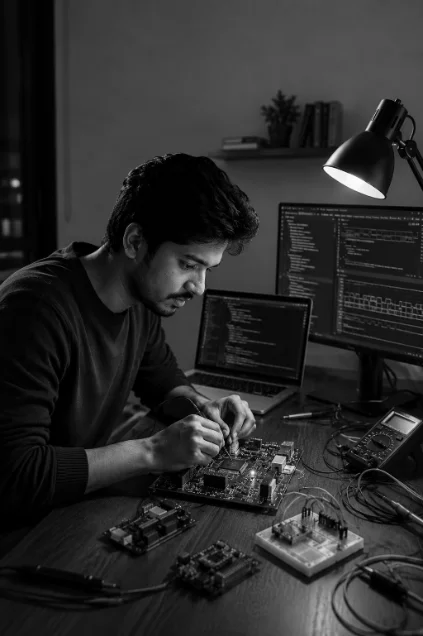
— NASEEF A K
Portrait — bench, working, greyscale
Fig. 6.1 — Naseef A K, bench setup
7.0Engagement models
Commitment
One engagement at a time
Taking on
Review and architecture first
Briefs
Always open
MODEL-RV

Review & audit

I read the firmware, the schematic and the failure reports, then tell you where this design will break — timing, state ownership, update safety, production testability — and what I would change first.

Scope
Code and architecture review, ranked findings, written recommendation
Duration
1–2 weeks
Rate
On request
Best when something works on the bench and nobody trusts it in the field.
MODEL-AR

Architecture

I design the system and write the decisions down — where state lives, what each board owns, transport and framing, update and recovery behaviour — so your team can build it without guessing.

Scope
Architecture document, interface contracts, decision record, review sessions
Duration
4–8 weeks
Rate
On request
Best when you have engineers but the split between MCU and host is still an argument.
MODEL-EX

Execution

Defined firmware work against an architecture that already exists: board bring-up, drivers written from the datasheet, one subsystem, the secure update path, or the production test tool.

Scope
Bring-up, drivers, one subsystem or the OTA path, delivered with tests
Duration
3–8 weeks
Rate
On request
Best when the plan is settled and one piece needs a senior owner.
8.0Contact

Start with a call. Bring the block diagram, or the argument you’re having about it.

30 minutes. I’ll tell you whether the timing budget is realistic, where I think the state should live, and what I’d architect differently — whether or not you hire me.

Reply within one business day. Async by default.
> Prefer to write first

Send the shape of the system and the constraint that worries you. Five fields, no funnel.

Project brief form →